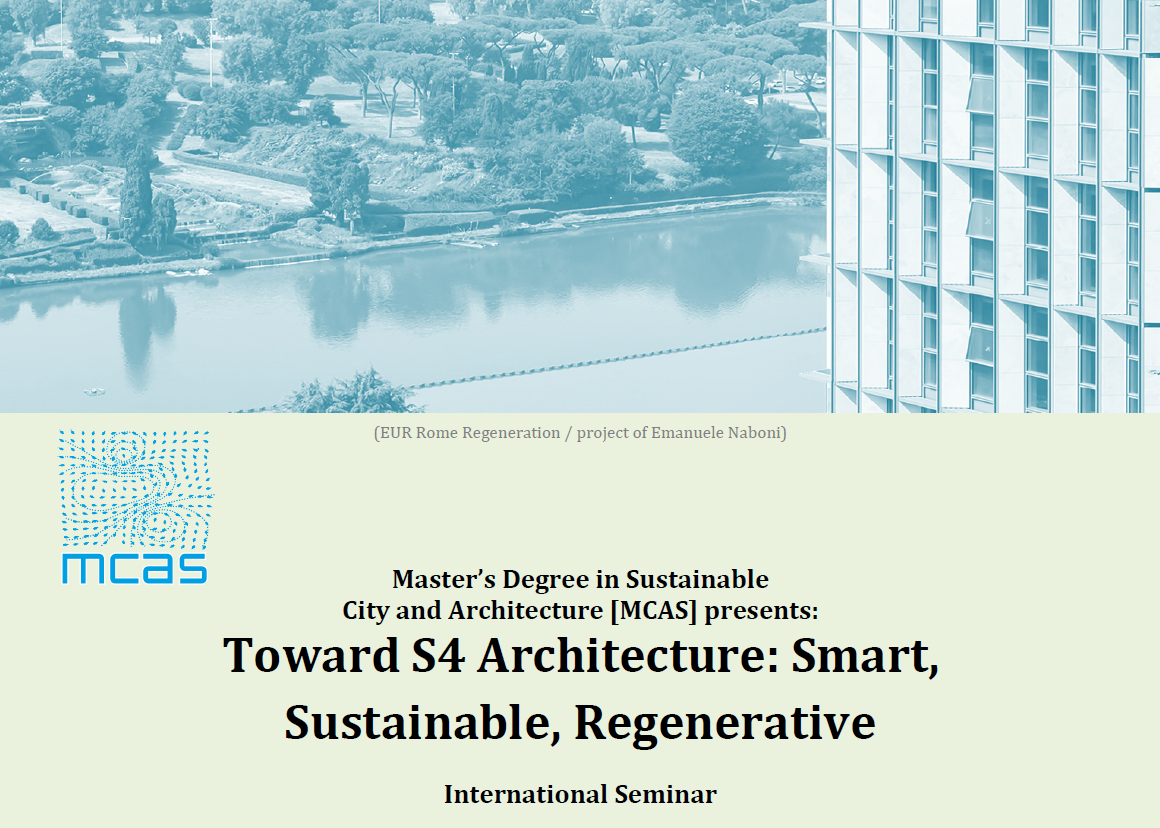
Master’s Degree in Sustainable City and Architecture [MCAS] presents:
Toward S4 Architecture: Smart, Sustainable, Regenerative International Seminar
Date: Tuesday 17 March 2026
Time: 09:30–14:00 and 16:00–20:00
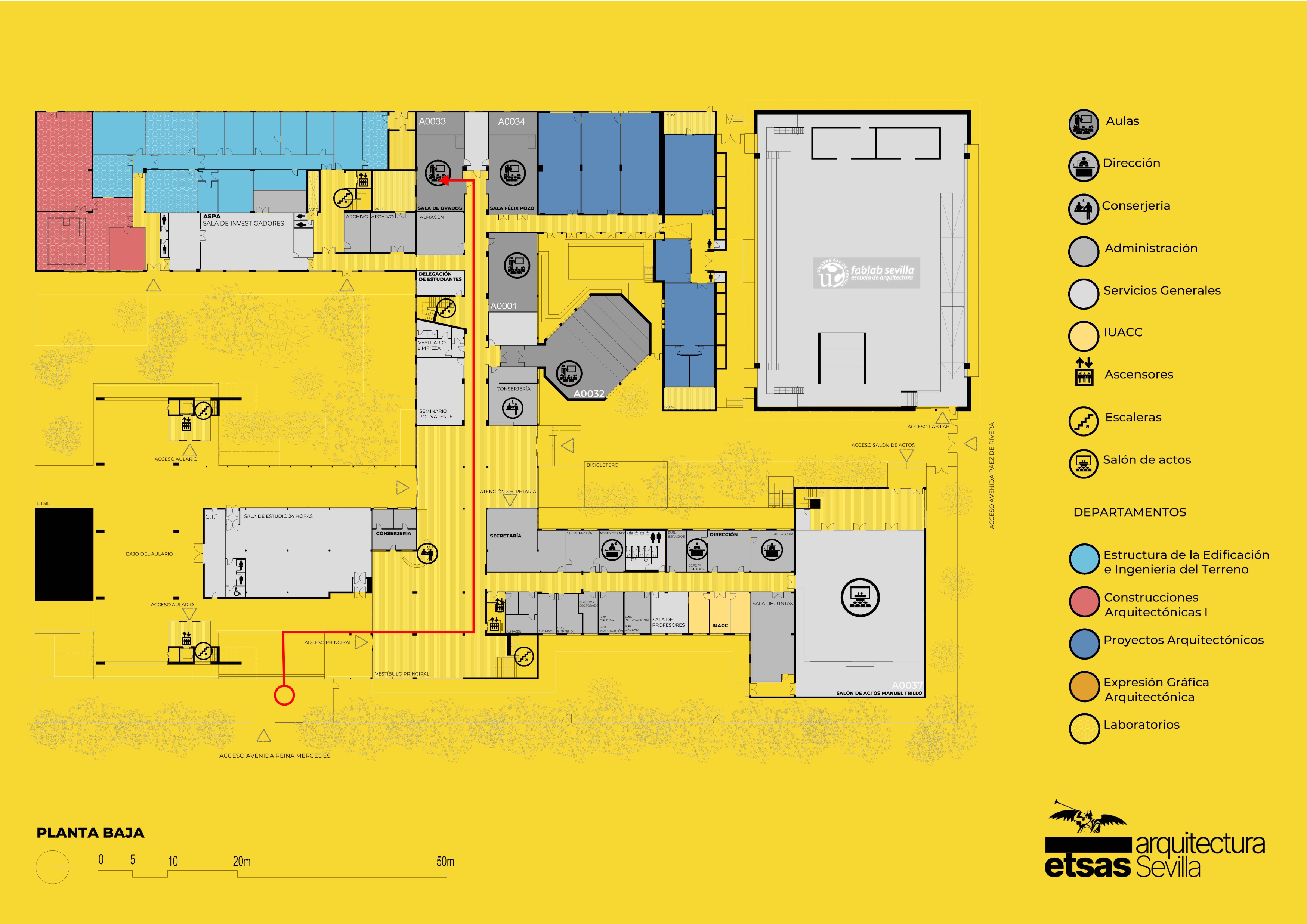
Venue: Sala de Doctorado, A0033 ground floor, ETSAS — University of Seville
Organisers:
Prof. Dr. Emanuele Naboni (Distinguished Professor at ETSAS)
Prof. Carlos Tapia Martín (Professor at ETSAS, Director of MCAS Master’s Degree)
Registrations: mcas@us.es (in the subject line: MCAS S4 Seminar, info: Name as you wish it to appear on the certificate of attendance; email address; indicate if you wish to validate this course in the Doctorate Programme in Architecture at the University of Seville as a formative activity)
Certificate: with a minimum attendance rate of 80% (in TEAMS, enter your full name when logging in)
Language: English Attendance mode: virtual via TEAMS and/or in person
Programme in pdf:
Theme
Toward S4 Architecture: Smart, Sustainable, Regenerative is conceived as an advanced academic forum dedicated to examining the transformation of architectural practice within the broader European transition from Smart Specialisation (S3) to Sustainable Smart Specialisation (S4). Over recent decades, sustainability has become embedded in architectural discourse through energy efficiency standards, carbon accounting protocols, environmental simulation tools and certification systems. Yet accelerating climate disruption, resource depletion and socio-ecological fragility require a deeper structural recalibration of the discipline. This seminar frames S4 Architecture as a systemic integration of computational intelligence, climate-responsive design, low-carbon renovation strategies, behavioural performance analysis and nature-based regeneration. The ambition is to consolidate a coherent paradigm in which digital tools, environmental metrics and ecological processes operate within a unified regenerative framework.
Within this perspective, “smart” designates the integration of data-driven modelling, parametric optimisation and environmental simulation as operative instruments for design decision-making across scales. “Sustainable” refers to measurable performance in energy, materials, lifecycle assessment and carbon reduction. “Regenerative” identifies an architectural capacity to restore ecosystems, enhance biodiversity, support multispecies coexistence and generate positive environmental feedback loops within urban and territorial systems. The invited scholars contribute complementary expertise to this expanded field: computational morphogenesis embedding ecological criteria into formal generation; climate-driven parametric modelling anticipating future weather scenarios and heat stress conditions; adaptive envelopes and deep renovation strategies addressing Europe’s aging building stock; rating systems and certification frameworks shaping energy-transition governance; and bioclimatic systems, vertical greenery and urban agriculture redefining buildings as active ecological interfaces.
The seminar foregrounds a central question for contemporary architectural technology: how can quantitative performance frameworks align with ecological agency and territorial resilience? Environmental metrics provide indispensable evaluation tools, yet regenerative practice demands integration with behavioural dynamics, spatial culture and urban metabolism. Adaptive façades, climate-responsive skins and vertical green systems therefore acquire significance as mediating infrastructures connecting atmospheric processes, building performance and human occupation. Certification mechanisms, including industrial and urban sustainability standards, influence not only compliance but also design culture and operational practices. Computational modelling enables predictive analysis, optimisation and scenario testing, allowing architecture to engage proactively with climate adaptation and energy-transition objectives.
The S4 framework proposed here operates across material assemblies, individual buildings, neighbourhood systems and territorial ecologies. It recognises architecture as an interface between digital intelligence, environmental performance, regulatory instruments and living systems. In the European context, decarbonisation targets, circular-economy directives and resilience agendas increasingly require integrative design methodologies capable of linking innovation ecosystems with socio-ecological transformation. Architectural research and education thus face the responsibility of articulating technological sophistication with ecological restoration and social adaptation.
Structured through lectures followed by extended debates, the seminar establishes a dialogical environment in which methodological assumptions, technical strategies and theoretical positions are critically examined. This format encourages cross-pollination between computational design, envelope engineering, certification systems and nature-based regeneration, fostering a shared vocabulary for S4 Architecture. The objective is to clarify how architectural intelligence can contribute to climate adaptation, energy transition and ecological enhancement through measurable yet systemic interventions. By consolidating these perspectives within a single academic platform, Toward S4 Architecture advances a disciplinary orientation that integrates smart technologies, sustainable performance and regenerative capacity into a cohesive research and pedagogical agenda, reinforcing architecture’s role in shaping resilient, low-carbon and ecologically productive environments.
Programme
Morning session
09:30–09:40 Welcome Address — Prof. Carlos Tapia Martín
09:40–09:45 Opening & framing — Organisers (S4 conceptual structure and seminar logic, publication)
09:45–11:05 Computational Regeneration: Algorithmic Architecture for Ecological Engineering — Toni Kotnik (Aalto University) (60’ lecture + 20’ discussion)
11:05–12:15 Supporting the EU transition to a carbon-neutral environment: Climate-Adaptive Building Envelope Design — Jacopo Gaspari (University of Bologna) (50’ lecture + 20’ discussion)
12:15–12:35 Break — —
12:35–13:45 From Sustainable to Regenerative Design: Rethinking Building Performance across the Life-Cycle — Lia Marchi (University of Bologna) (50’ lecture + 20’ discussion)
13:45–14:00 Open discussion & transition — Organisers (Key takeaways and questions for the afternoon)
14:00–16:00 Lunch break — —
Afternoon session
16:00–17:10 Nature-Based Regeneration within Regenerative Design: Methodological Development and Critical Boundaries — Maicol Negrello (Politecnico di Torino) (50’ lecture + 20’ discussion)
17:10–18:20 Creative Regenerative Design: Ecology, Decarbonisation and Health in Climate-Change Coordinates — Emanuele Naboni (University of Seville) (50’ lecture + 20’ discussion)
18:20–18:40 Break — —
18:40–19:40 Round Table: Integrating Intelligence, Performance and Regeneration — All speakers (Moderated discussion and synthesis)
19:40–20:00 Closing remarks & networking — Organisers
Speakers — titles, abstracts and bios
Toni Kotnik — Aalto University
Computational Regeneration: Algorithmic Architecture for Ecological Engineering
Abstract: The continued degradation of our natural environment requests an architecture of regeneration that is architectural design consistent with ecological principles, designs which integrate human needs with its natural environment for the benefit of both. Future architectural designs and developments of our built environment need the be able to restore the capacity of our ecosystems. Such active agency requires novel design methods. The lecture will discuss in particular the role of computational, algorithmic approaches as creative mediator between the physical needs of ecosystems and the freedom of design. A number of experimental architectural designs for the reuse of parts of the former cargo harbor of Helsinki for the restoration of seagrass meadows will illustrate the potential of utilizing architectural methods for the design of ecological niches.
Bio: Toni Kotnik is Professor of Design of Structures at Aalto University. His practice and research work has been published and exhibited internationally, including the Venice Biennale, and is centered on the exploration of organizational principles and formal design methods at the intersection of science and art.
Jacopo Gaspari — University of Bologna
Supporting the EU transition to a carbon-neutral environment: Climate-Adaptive Building Envelope Design
Abstract: The transition towards a carbon neutral environment calls for a paradigm shift from the conventional idea of energy efficient building solutions to a comprehensive response capacity to climate-driven conditions which are increasingly growing in intensity, frequency and severity. On the one hand the building envelope is expected to adjust its configuration to external solicitation to maintain optimal comfort conditions while saving as much energy as possible and reducing the dependency of comfort levels on mechanical systems. On the other hand, it is becoming imperative that building skin does not negatively impact on the immediate surrounding spaces and if possible, contributes to mitigating outdoor conditions. This requires widening the reflection on the way building envelopes and the whole shape of the volume are designed beyond the individual challenges considering them integrated into the broader context and the upcoming challenges in a real forward-looking perspective.
Bio: Jacopo Gaspari. Architect, PhD, Professor of Architectural Technology at the Department of Architecture of the University of Bologna, Italy. He has participated in and coordinated several international research projects concerning the transition to a low-carbon built environment. He deals with sustainable architecture, energy efficiency, circularity, and adaptation of buildings to climate change. Founder of the NEXTBUILT Observatory on the future of the built environment.
Lia Marchi — University of Bologna
From Sustainable to Regenerative Design: Rethinking Building Performance across the Life-Cycle
Abstract: Certification schemes for building performance have progressively expanded from energy efficiency toward broader sustainability, resilience, and circularity goals. Frameworks such as U.S. GBC’s LEED now integrate life-cycle assessment, material traceability, waste reduction, and adaptive reuse credits, reflecting a systemic shift in how value is defined in the built environment. Building on this evolution, the lecture explores how regenerative design can apply to diverse stages of building life cycle. A pathway to transform agricultural, industrial, and urban waste streams into high-performance thermal insulation for building retrofit is presented to support energy transition while reframing waste as a resource. Then, regenerative potential at design stage is discussed, through flexibility and adaptability – outlining spatial, structural, and service-based strategies by means of practical project design. Off-site construction also plays a pivotal role in this shift, and it is addressed as a lever for regeneration beyond the building site, emphasizing design for disassembly, durability, and recyclability from the production phase onward. The main goal is to highlight how these approaches are increasingly operationalized by professionals, also thanks to certification systems increasing support.
Bio: Lia Marchi. Architect, PhD, Researcher at the Department of Architecture of the University of Bologna, Italy. She is an expert in certification systems and circular design. She deals with energy transition in the built environment, systems and solutions for off-site construction, circularity, solutions for energy efficiency and building-user interaction, and sustainable design of industrial sites. Founder of the NEXTBUILT Observatory on the future of the built environment.
Maicol “Mike” Negrello — Politecnico di Torino
Nature-Based Regeneration within Regenerative Design: Methodological Development and Critical Boundaries
Abstract: This contribution explores Regenerative Design through the lens of nature-based regeneration, framing it as a systemic and multi-scalar approach rather than a performance-driven objective. Regenerative Design is examined as a process that operates across nested spatial scales — from building envelopes and bioclimatic systems to vertical greenery, urban agriculture, and territorial ecologies — in which architecture is part of broader socio-ecological systems. The lecture presents ongoing research aimed at developing an experimental set of regenerative KPIs to evaluate systemic coherence, ecological integration, and scalar consistency within projects. These indicators are currently in a testing phase and are treated as provisional tools rather than definitive metrics. The contribution critically addresses the limits of measuring regeneration, including scale dependency, temporal misalignment between ecological and architectural cycles, and the risk of reducing ecological complexity to simplified assessment frameworks. By acknowledging these tensions, the presentation argues that Regenerative Design should be understood as a directional process toward increased ecological reciprocity, rather than as a fully certifiable or guaranteed outcome.
Bio: Maicol «Mike» Negrello is an architect and post-doc researcher at Politecnico di Torino (DAD). His work focuses on Regenerative Design and nature-based regeneration as multi-scalar frameworks for climate-adaptive urban design and architecture, integrating ecological and various metrics across research, teaching, and practice.
Emanuele Naboni — University of Seville
Creative Regenerative Design: Ecology, Decarbonisation and Health in Climate-Change Coordinates
Abstract: This lecture proposes a creative, evidence-informed approach to regenerative design that links ecological performance, decarbonisation pathways and human health within climate-change coordinates. Rather than treating carbon, biodiversity and wellbeing as separate checklists, the talk frames them as coupled design drivers that can be mapped, quantified and translated into spatial strategies across scales—from envelope and microclimate to district metabolism and landscape systems. Through digital workflows (parametric modelling, simulation and carbon accounting) the lecture shows how design can move from impact mitigation to positive feedback loops: cooling and shading that reduce heat stress, material strategies that cut embodied emissions, and ecological interfaces that increase habitat value. The focus is on operational methods that remain measurable, teachable and applicable to practice.
Organiser Bio
Prof. Dr. Emanuele Naboni
Bio: Prof. Dr. Emanuele Naboni is Distinguished Professor at the University of Seville and a global practitioner in regenerative digital design. He has worked for years with SOM and he was Professor at the Royal Danish Academy, the Norman Foster Institute, IAAC, ETH Singapore, EPFL and UC Berkeley (incl. Lawrence Berkeley National Laboratory). He has supported EU, IPCC- WHO, He has contributed to 300+ built projects worldwide across masterplans and buildings, worked and at more than 200 built prototypes and scripted software now widely used in the AEC community.
Prof. Carlos Tapia Martín — University of Seville
Bio: Prof. Carlos Tapia Martín is Professor at ETSAS (Higher Technical School of Architecture, Department of History, Theory and Composition in Architecture), University of Seville, and Director of the MCAS Master’s Degree in Sustainable Cities and Architecture. He coordinates the institutional framing of the programme, supports doctoral training activities, and facilitates academic dissemination and publication initiatives linked to sustainable and resilient community agendas.
Key information:
1. Smart Specialisation Strategies (S3)
European Commission – Smart Specialisation (S3) Community of Practice
About Smart Specialisation (European Commission)
This official European Commission website explains the conceptual framework of Smart Specialisation Strategies, a central component of the EU’s cohesion policy. S3s aim to promote knowledge-based growth through regional innovation strategies that capitalise on the specific capabilities and assets of each region.
Joint Research Centre – S3 Knowledge Hub
S3 Knowledge Hub – Joint Research Centre (European Commission)
JRC (Joint Research Centre) coordinates the S3 scientific platform, which provides methodologies, data, courses and tools for designing regional smart specialisation strategies.
2. Sustainable Smart Specialisation (S4 / S4+)
The S4 is a conceptual framework developed by the Joint Research Centre to integrate sustainability, the green transition and social objectives into regional innovation strategies.
JRC report – Place-based innovation for sustainability / transition to S4
Fostering the Green Transition through Smart Specialisation (JRC report)
This JRC report examines how S3 strategies can evolve into sustainability-oriented approaches, in line with the European Green Deal and the green and digital transitions.
Explanation of the shift from S3 to S4
From S3 to S4+: Smart Specialisation for Sustainable and Inclusive Growth
This resource outlines the conceptual shift towards S4+, which introduces a focus on social and environmental challenges, reinforcing the territorial innovation approach to addressing issues such as climate change and energy transitions
References
Carayannis, E. G., Grigoroudis, E., Campbell, D. F. J., Meissner, D., & Stamati, D. (2022). Ambidextrous, robust and resilient impact assessment frameworks: A structural approach for evaluating sustainable smart specialisation strategies. Journal of the Knowledge Economy, 13, 2400–2431. https://doi.org/10.1007/s13132-022-00991-2
Foray, D. (2015). Smart specialisation: Opportunities and challenges for regional innovation policy. Routledge. https://doi.org/10.1080/00343404.2015.1007572
Foray, D., David, P. A., & Hall, B. H. (2011). Smart specialisation: From academic idea to political instrument, the surprising career of a concept and the difficulties involved in its implementation. MTEI Working Paper. https://infoscience.epfl.ch/record/170252
Kim, K. (2024). Smart specialisation strategies and regional knowledge spaces: Evidence from European regions. Regional Studies. Advance online publication. https://doi.org/10.1080/00343404.2024.2355985
Kogut-Jaworska, M. (2023). Do regional smart specialisation strategies affect innovation development? Evidence from European regions. Sustainability, 15(23), 16405. https://doi.org/10.3390/su152316405
McCann, P., & Ortega-Argilés, R. (2015). Smart specialisation, regional growth and applications to European Union cohesion policy. Regional Studies, 49(8), 1291–1302. https://doi.org/10.1080/00343404.2013.799769
Moujaes, G. (2024). Moving to smart specialisation for sustainability. Science and Public Policy, 51(1), 127–140. https://doi.org/10.1093/scipol/scad056
 master universitario en ciudad y arquitectura sostenibles (mcas)